 |
|
THE RECORD BOOKS |
| Session | Folio | |
| Charlestown, 29 January 1760 | 1r | |
| Boston, 19 February 1760 | 10r | |
| Plimouth, 29 April 1760 | 32r | |
| Barnstable, 6 May 1760 | 42r | |
| Ipswich, 24 June 1760 | 52r | |
| York, 1 July 1760 | 65r | |
| Cambridge, 5 August 1760 | 79r | |
| Boston, 19 August 1760 | 93r | |
| Worcester, 16 September 1760 | 114r | |
| Springfield, 23 September 1760 | 124r | |
| Taunton, 15 October 1760 | 144r | |
| Salem, 21 October 1760 | 154r | |
| Charlestown, 27 January 1761 | 161r | |
| Boston, 17 February 1761 | 166v | |
| Plymouth, 12 May 1761 | 181v | |
| Barnstable, 7 May 1761 | 188r | |
| Ipswich, 9 June 1761 | 192r | |
| York, 16 June 1761 | 198v | |
| Falmouth, 23 June 1761 | 208r | |
| Cambridge, 4 August 1761 | 210v | |
| Boston, 18 August 1761 | 221r | |
| Worcester, 15 September 1761 | 239v | |
| Springfield, 22 September 1761 | 250r | |
| Taunton, 18 October 1761 | 264r | |
| Salem, 24 October 1761 | 272r | |
| Charlestown, 26 January 1762 | 278r | |
| Boston, 16 February 1762 | 288r | |
| Plimouth, 27 April 1762 | 323r | |
| Barnstable, 4 May 1762 | 330r | |
| Ipswich, 8 June 1762 | 337r | |
| York, 15 June 1762 | 348r | |
| Falmouth, 22 June 1762 | 361r | |
| Cambridge, 3 August 1762 | 369r | |
| Boston, 17 August 1762 | 380r | |
| Worcester, 21 September 1762 | 402r | |
| Springfield, 28 September 1762 | 416r | |
| Taunton, 12 October 1762 | 437r | |
| Salem, 19 October 1762 | 452r |
MARITIME CASES 1779–1783, 1788
| Session | Folio | |
| Ipswich, 15 June 1779 | 1r | |
| Boston, 31 August 1779 | 16r | |
| Boston, 15 February 1780 | 26r | |
| York, 27 June 1780 | 31r | |
| Boston, 29 August 1780 | 32r | |
| Cambridge, 14 November 1780 | 35r | |
| Concord, 10 April 1781 | 38r | |
| Ipswich, 18 June 1781 | 42r | |
| Falmouth, 3 July 1781 | 45r | |
| Boston, 28 August 1781 | 47r | |
| Taunton, 16 October 1781 | 52r | |
| Cambridge, 30 October 1781 | 52v | |
| Salem, 6 November 1781 | 53r | |
| Boston, 19 February 1782 | 56r | |
| Barnstable, 16 May 1782 | 61r | |
| York, 25 June 1782 | 62v | |
| Falmouth, 2 July 1782 | 64r | |
| Boston, 19 November 1782 | 66v | |
| Cambridge, 10 December 1782 | 69r | |
| Boston, 18 February 1783 | 71r | |
| Concord, 8 April 1783 | 73r | |
| Plymouth, 20 May 1783 | 76v | |
| Ipswich, 17 June 1783 | 82v | |
| Boston, 26 August 1783 | 84v | |
| Taunton, 25 November 1783 | 90v | |
| Concord, 13 April 1783 | 95v | |
| Taunton, 23 October 1788 | 100r |
For purposes of the 1725–1730 volume that we publish here, the main point of what follows is that what we publish here does not contain all the records of the sessions from those years. To get to that point requires a survey of the dates of all the volumes that we have and specific discussion of the contents of those volumes clustered around 1725–1730.
As noted above, the transcriptions that we are making of the surviving records of the Massachusetts Superior Court of Judicature are being made from microfilms. The following table lists the films with their reel numbers, the first and last visible dates on the reel, and an estimate of the number of years missing between the last date mentioned, and the first date in what seems to be the next volume chronologically.
MICROFILMS OF THE RECORDS OF THE SJC, 1686–1788
| Reel no.5 | Start | End | Missing |
| 7943507 | 1686 | 1694 | 5 |
| 7943508 | 1700 | 1714 | 4 |
| 7943509 | 1719 | 1720 | 0 |
| 7943510 | 1721 | 1729 | 0 |
| 7943511 | 1725 | 1730 | 0 |
| 7943512 | 1728 | 1734 | 0 |
| 7943513 | 1733 | 1738 | 0 |
| 7943514 | 1738 | 1740 | 0 |
| 7942984 | 1740 | 1745 | 0 |
| 7942985 | 1743 | 1750 | 0 |
| 7942986 | 1750 | 1753 | 0 |
| 7942987 | 1753 | 1754 | 0 |
| 7939671 | 1755 | 1759 | 0 |
| 7942988 | 1760 | 1762 | 0 |
| 7942989 | 1763 | 1765 | 0 |
| 7939672 | 1766 | 1769 | 0 |
| 7942990 | 1769 | 1770 | 0 |
| 7942991 | 1771 | 1772 | 0 |
| 7942992 | 1773 | 1774 | 3 |
| 7942993 | 1778 | 1780 | 0 |
| 7942994 | 1781 | 1782 | 0 |
| 7942995 | 1779 | 1788 | maritime6 |
5The reels are numbered in three consecutive series: 7939671–7939672, 7939684–7939695, and 7943507–7943514. As already noted above and published on this site, reel no. 7942995 is unique. It contains maritime cases from the late 18th century. The remaining 21 reels contain annual volumes or pieces of them.
The starting and ending dates are, for the most part, taken from the headings of the sessions. In eight cases, they seem to proceed in chronological order, with the next volume picking up at the beginning of the next calendar year. In five cases, they seem proceed in chronological order, and end in mid-year, with the next volume picking up in the second half of the same year. There are five years that seem to be missing at the end of 17th century, four between 1714 and 1719, and three between 1774 and 1778. The last named are the easiest to explain. It is quite possible that no such records were compiled during the years of the British occupation. The missing years at the end of the 17th century and near the beginning of the 18th could be explained by the fact that the decision to make up bound volumes of the records of the sessions of the court was taken sometime in 1720s or early1730s. At that point nine years’ worth of earlier sessions could not be found.
That binding the volumes of the records of the sessions was a new idea in 1720s or early1730s might also explain the peculiar chronology of reel nos. 7943510 through 7943513. 7943511 seems to overlap at the beginning with 7943510 and at the end with 7943512. 7943513 seems to overlap with 7943512 at the beginning. With this idea in mind we explored the session headings on all four reels, beginning with a table of contents found in 7943511, the volume published here in PDF. Immediately below is an image of what appears in the manuscript (image 009), followed by our edition of it. That edition is repeated in the PDF with annotations.
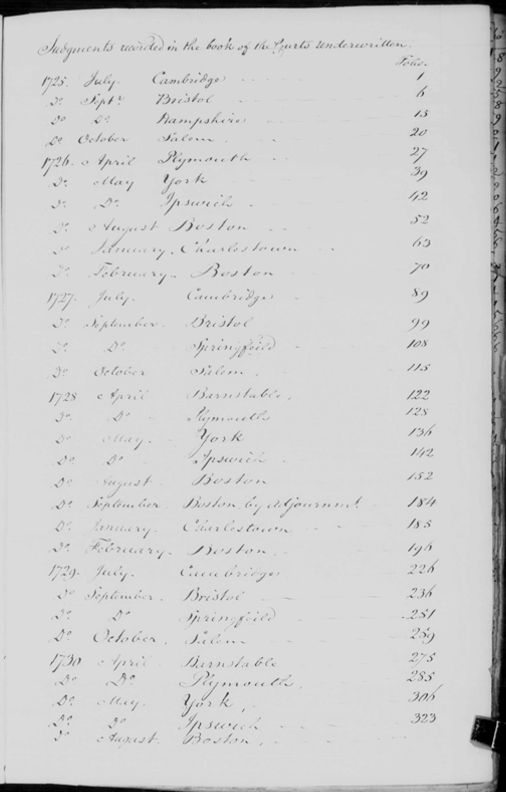
CONTENTS OF THE 1725–1730 VOLUME
| No. | Session | Folio | |
| 1 | Cambridge, 27 July, 1725 | 1r | |
| 2 | Bristol, 14 September, 1725 | 6r | |
| 3 | Springfield, 28 September, 1725 | 15v | |
| 4 | Salem, 26 October, 1725 | 20r | |
| 5 | Plymouth, 6 April, 1726 | 27r | |
| 6 | York, 11 May, 1726 | 39r | |
| 7 | Ipswich, 17 May, 1726 | 42v | |
| 8 | Boston, 9 August, 1726 | 50v | |
| 9 | Charlestown, 31 January, 1727 | 63v | |
| 10 | Boston, 14 February, 1727 | 70v | |
| 11 | Cambridge, 5 July, 1727 | 89v | |
| 12 | Bristol, 12 September, 1727 | 99r | |
| 13 | Springfield, 26 September, 1727 | 108r | |
| 14 | Salem, 31 October, 1727 | 115v | |
| 15 | Barnstable, 23 April, 1728 | 122r | |
| 16 | Plymouth, 30 April, 1728 | 128v | |
| 17 | York, 15 May, 1728 | 136v | |
| 18 | Ipswich, 21 May, 1728 | 142v | |
| 19 | Boston, 13 August, 1728 | 152r | |
| 20 | Boston, 5 September, 1728 | 184r | |
| 21 | Charlestown, 8 January, 1729 | 185v | |
| 22 | Boston, 11 February, 1729 | 196r | |
| 23 | Cambridge, July., 1729 | 226v | |
| 24 | Bristol, 9 September, 1729 | 236v | |
| 25 | Springfield, 3 September, 1729 | 251r | |
| 26 | Salem, 28 October, 1729 | 259v | |
| 27 | Barnstable, 21 April, 1730 | 275r | |
| 28 | Plymouth, 28 April, 1730 | 285v | |
| 29 | York, 13 May, 1730 | 306v | |
| 30 | Ipswich, 19 May, 1730 | 323r | |
| 31 | Boston, 11 August, 1730 | 334v |
The 18th-century clerk did a good job. He got all the headings, and the only error that he made was in session 8 where the folio number should be 50 not 52.
Reel no. 7943510 has a contemporary table of contents (image no. 009) entitled, as was the one for 7943511, ‘Judgments recorded in this Book of the Courts Underwritten’:
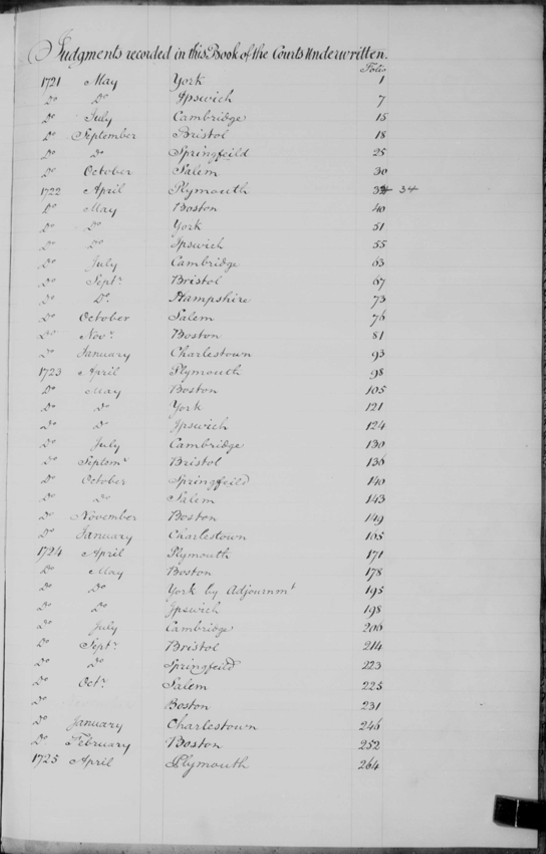
As can be seen from the image, the sessions end with a session in Plymouth in April of 1725 before the 1725–1730 volume starts. That session begins on fol. 264 and ends on fol. 269. There follows an image of the spine of a new volume, a series of unfoliated housekeeping images, and a new table of contents without a heading other than penciled dates at the top which are probably much later (image 345):
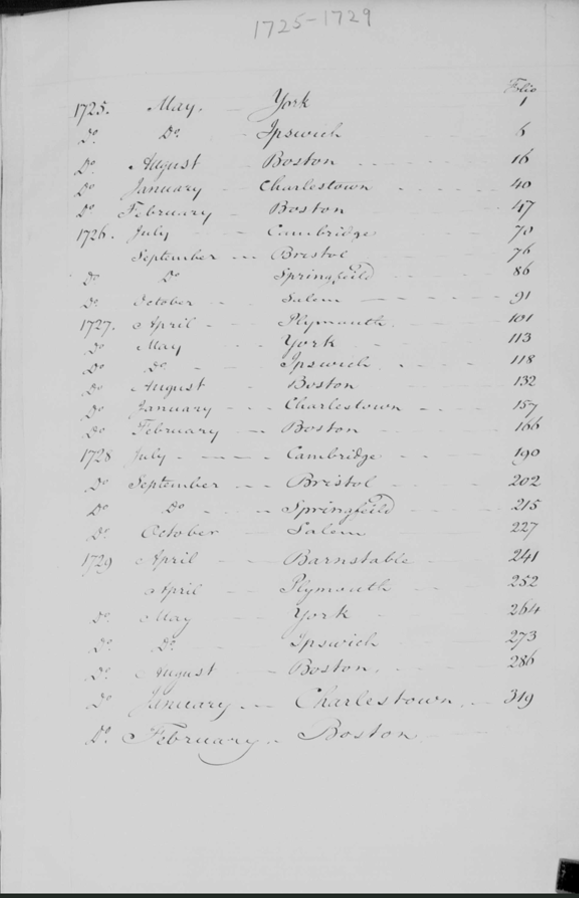
As can be seen from the image, the months, places, and accompanying years are entirely different from those in the 1725–1730 volume, and so are the following contents. They are, however, from years that correspond to the years in the 1725–1730 volume. We suspect that the recording of these sessions is the work of a clerk different from the one who wrote up the sessions in the 1725–1730 volume, but further analysis of the handwriting is called for.
Reel no. 7943512, unfortunately, does not begin with a table of contents, it is also missing an image of fol. 1r, though that folio clearly exists, because we have an image of fol. 1v.7 The first case on that page tells us that it concerns an appeal from the Court of Common Pleas held in Charlestown on the second Tuesday of March (11 March) in 1728/9. There does not seem to be a record of the adjournment of this session of the Superior Court. We will suggest below that this is the record of a session held in Cambridge in July of 1730.
7 There may be a table of contents on the left side of fol. 1r, which the photographer seems to have skipped.
The first heading that we have found in 7943512 is on fol. 20r, following a blank fol. 19v. It begins a session of the court at Bristol on 8 September 1730, hence after the last date in the 1725–1730 volume.
Fol. 304v, has a heading for a session held at Worcester, 16 September 1733, said to be the Wednesday immediately before the session ‘appointed by law’ to be held at Springfield. (Worcester is 57 miles from Springfield. The county of Worcester was established in 1731.) The day appointed by law had previously been the fourth Tuesday in the month. The bottom of fol. 311v records the adjournment sine die of the Worcester session on 24 September. If that is correct, the justices did not make it to Springfield for the day appointed by law, but that day may have been changed when the Worceester session was added. Fol. 312r also has a heading for a session in Worcester, dated 17 September 1734. Fol. 318v, the last folio in the reel that has original writing on it, records the adjournment of this session at Worcester on 29 September 1734.8
8 The matching of the days of the week and the days of month recorded in both headings does not seem to correspond to the actual ones in those years. That fact raises a problem that requires further exploration.
Reel no. 7943513, the volume for 1733–1736, has a table of contents (image 011), which follows:
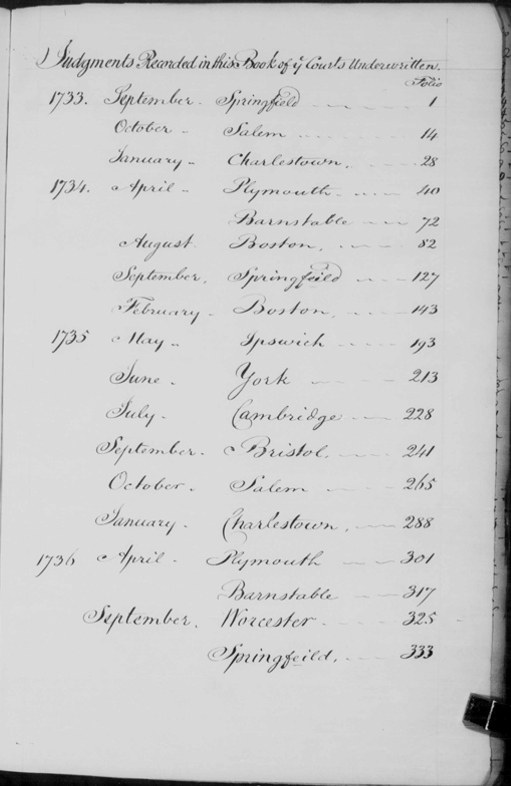
Hence, the second of the two Worcester sessions recorded in reel no. 7943512 overlaps chronologically with the sessions recorded here. The first, however, does not. It occurred just before the first session in this volume.
Turning specifically to years 1725–1730, the following table gives the year, month, and place of the session, followed by the number of the reel on which is found, and the folio number where it begins. (In the case of reel no. 7943510, the folio numbers for the first two are from the first volume on the reel; those that follow are from the second.) The table is in chronological order from 1 January 1725 n.s. to 31 December 1730.
1725–1730 – ALL SESSIONS
| No. | Year | Month | Place | Reel | Folio |
| 1 | 1725 | January | Charlestown | 510 | 246 |
| 2 | 1725 | February | Boston | 510 | 264 |
| 3 | 1725 | April | Plymouth | 510 | 1 |
| 4 | 1725 | May | York | 510 | 16 |
| 5 | 1725 | May | Ipswich | 510 | 20 |
| 6 | 1725 | July | Cambridge | 511 | 1 |
| 7 | 1725 | August | Boston | 510 | 5 |
| 8 | 1725 | September | Bristol | 511 | 6 |
| 9 | 1725 | September | Springfield | 511 | 15 |
| 10 | 1725 | October | Salem | 511 | 20 |
| 11 | 1726 | January | Charlestown | 510 | 40 |
| 12 | 1726 | February | Boston | 510 | 47 |
| 13 | 1726 | April | Plymouth | 511 | 27 |
| 14 | 1726 | May | York | 511 | 39 |
| 15 | 1726 | May | Ipswich | 511 | 42 |
| 16 | 1726 | July | Cambridge | 510 | 70 |
| 17 | 1726 | August | Boston | 511 | 50 |
| 18 | 1726 | September | Bristol | 510 | 76 |
| 19 | 1726 | September | Springfield | 510 | 86 |
| 20 | 1726 | October | Salem | 510 | 91 |
| 21 | 1727 | January | Charlestown | 511 | 63 |
| 22 | 1727 | February | Boston | 511 | 70 |
| 23 | 1727 | April | Plymouth | 510 | 101 |
| 24 | 1727 | May | York | 510 | 113 |
| 25 | 1727 | May | Ipswich | 510 | 118 |
| 26 | 1727 | July | Cambridge | 511 | 89 |
| 27 | 1727 | August | Boston | 510 | 132 |
| 28 | 1727 | September | Bristol | 511 | 99 |
| 29 | 1727 | September | Springfield | 511 | 108 |
| 30 | 1727 | October | Salem | 511 | 115 |
| 31 | 1728 | January | Charlestown | 510 | 157 |
| 32 | 1728 | February | Boston | 510 | 166 |
| 33 | 1728 | April | Barnstable | 511 | 122 |
| 34 | 1728 | April | Plymouth | 511 | 128 |
| 35 | 1728 | May | York | 511 | 136 |
| 36 | 1728 | May | Ipswich | 511 | 142 |
| 37 | 1728 | July | Cambridge | 510 | 190 |
| 38 | 1728 | August | Boston | 511 | 152 |
| 39 | 1728 | September | Boston | 511 | 184 |
| 40 | 1728 | September | Bristol | 510 | 202 |
| 41 | 1728 | September | Springfield | 510 | 215 |
| 42 | 1728 | October | Salem | 510 | 227 |
| 43 | 1729 | January | Charlestown | 511 | 185 |
| 44 | 1729 | February | Boston | 511 | 196 |
| 45 | 1729 | April | Barnstable | 510 | 241 |
| 46 | 1729 | April | Plymouth | 510 | 252 |
| 47 | 1729 | May | York | 510 | 264 |
| 48 | 1729 | May | Ipswich | 510 | 273 |
| 49 | 1729 | July | Cambridge | 511 | 226 |
| 50 | 1729 | August | Boston | 510 | 286 |
| 51 | 1729 | September | Bristol | 511 | 236 |
| 52 | 1729 | September | Springfield | 511 | 251 |
| 53 | 1729 | October | Salem | 511 | 259 |
| 54 | 1730 | January | Charlestown | 510 | 319 |
| 55 | 1730 | February | Boston | 510 | 336 |
| 56 | 1730 | April | Barnstable | 511 | 275 |
| 57 | 1730 | April | Salem | 511 | 285 |
| 58 | 1730 | May | York | 511 | 306 |
| 59 | 1730 | May | Ipswich | 511 | 323 |
| 60 | 1730 | July | Cambridge | 512 | 1 |
| 61 | 1730 | August | Boston | 511 | 334 |
| 62 | 1730 | September | Bristol | 512 | 20 |
| 63 | 1730 | September | Springfield | 512 | 41 |
| 64 | 1730 | October | Salem | 512 | 51 |
When all the sessions for which we have records are included, the pattern that emerges is quite regular: In 1725, there were two sessions in Middlesex County (Charlestown in January, Cambridge in July), two in Suffolk County (Boston in February and August), two in Essex County (Ipswich in May, Salem in October), and one each in Plymouth, York (now in Maine), Bristol, and Hampshire counties, held at Plymouth, York, Bristol (now in Rhode Island), and Springfield, respectively. The headings tell us that these sessions were scheduled for a particular day of the week within the month, e.g., the second Tuesday of September, the day of the month being that on which that day of the week fell.
The chronological order of the sessions in 1725 is repeated in the following five years. In 1728, a session in Barnstable and Dukes County was added at Barnstable before the session at Plymouth.9 (Previously, these counties had been combined with the session at Plymouth.) What looks like an extra session for Boston in 1728 really is not. The heading explains that the court picked up again in the first week of September when it had adjourned cum die at the end of August.
9 The justices probably went to Barnstable by boat from Boston, and visited Plymouth, also by boat, on their return. The same means of transportation was probably used for the existing York-Ipswich pattern.
The problematic session at the beginning of reel 512, which lacks a heading, can be assigned with some confidence to Cambridge in July of 1730. That follows the pattern of the previous five years. That session also begins with an appeal from the county court in Charlestown. Charlestown, like Cambridge, was in Middlesex County at the time, and having the appeal heard in Middlesex County would be essential if a jury were to be called in the appeal case.
The question then becomes why there are so many sessions that are chronologically within the years 1725–1730 not found in the volume that is so labelled? The difference is substantial. There were 64 sessions between 1 January 1730 and 31 December 1735, and only 31 of them are found in the 1725–1730 volume. An explanation may be found in session no. 7, the first one that should have been added to 511, assuming that 511 was to begin with the July session in Cambridge. Here is where the Boston session in July should have been added, before the Bristol session in September. The Bristol session, however begins in mid-page. The Boston session could not have been added to it without breaking up Bristol. Rather than doing that, the binders put it in a different volume. They were aware of what they had done. The presence of tables of contents in these volumes (which are not found elsewhere) can probably be explained by the fact that these volumes contain records of sessions that are not strictly in chronological order.
Charles Donahue, Jr.
This page last updated: 08/27/26. |
